

Best Party Games for Groups: 2026 Picks That Work
Table of Contents
- How to Pick the Best Party Games for Groups
- Large Group Games for Adults That Keep 15+ People Involved
- Easy Party Games for Groups That Take Under Five Minutes to Explain
- Indoor Party Games for Adults When the Weather or Space Rules Out the Garden
- Outdoor Party Games That Get Everyone Moving
- Mixing Ages and Abilities Without Splitting the Party
- Common Party Game Mistakes to Avoid
- Frequently Asked Questions
Last Updated: October 20, 2026
How to Pick the Best Party Games for Groups
The best party games for groups are the ones people actually finish. A game that needs ten minutes of explanation will lose the room before the first round ends.
So here is the filter we use before recommending anything. Ask three questions:
- How many people are playing? A game for six breaks down at twenty.
- How long does it take to explain? Under five minutes or it is a dud.
- What is the room like? Carpet and glassware rule out half the active options.
Get those three right and almost any game works. Get them wrong and even a brilliant game sits in the corner. Below, we break down the party games that survive real gatherings, sorted by group size, space and energy level.
Match the Game to the Room, Not the Hype
The biggest mistake hosts make is buying for the fantasy party, not the real one. A twenty-person garden party needs different games from a six-person dinner. A room with a low ceiling and a glass coffee table cannot host a balloon relay, however good the idea sounds.
Here is how we would map it:
| Group Size | Best Format | Avoid |
|---|---|---|
| 3-6 people | Conversational and card games | Relays and team sports |
| 7-12 people | Team trivia, Fishbowl, secret missions | Long single-turn games |
| 15+ people | Balloon relay, musical statues, capture the flag | Anything with one active player |
Space matters just as much. Indoor games for adults work best when they keep people seated or standing in place. Outdoor party games can be louder, messier and more physical.
Large Group Games for Adults That Keep 15+ People Involved
Large group games for adults fail for one reason: too many people waiting their turn. With fifteen or more guests, you need formats where everyone is active at once, or where teams keep the whole room moving.
| Game | Setup time | Play time | Materials | Works for |
|---|---|---|---|---|
| Team trivia showdown | 5 minutes | 20-40 minutes | Question sheets, pens, score sheet | 8-30 players |
| Fishbowl | 5 minutes | 20-30 minutes | Paper, pens, a bowl | 8-30 players |
| Secret missions | 10 minutes | All evening | Printed mission cards | 10-40 players |
| Balloon relay | 5 minutes | 10 minutes | Balloons, two markers for a course | 10-24 players |
| Human bingo | 5 minutes | 15-20 minutes | Printed bingo cards, pens | 15-50 players |
Our go-to picks for big groups, with the mechanics that make them work:
- Team trivia showdown. Split into teams of four or five. Read questions aloud, score on a sheet. Setup is five minutes, play is as long as you want. Keep teams mixed so one strong quizzer does not carry the whole table, and rotate the reader each round so nobody is stuck hosting.
- Fishbowl. Everyone writes a few prompts, drops them in a bowl, and teams guess in rounds. It scales from eight to thirty people without changing a thing. The three-round structure, describe, one word, charades, keeps energy rising rather than flattening.
- Secret missions. Deal each guest a small task, like getting someone to mention a specific word. The room does the work for you. Print missions on cards so guests can pocket them, and set a soft deadline ("complete three by pudding") to keep people mingling.
- Balloon relay. Two teams, a balloon between the knees, a course across the room. Ten minutes of chaos, no skill required. Mark the course with two chairs or cones and keep the route short so the whole team stays involved.
- Human bingo. Each guest gets a grid of descriptions ("has run a marathon", "speaks three languages") and must find someone who matches each square. It is the fastest way to break the ice at a large gathering and needs nothing more than printed sheets.
What most guides miss is that large groups need a facilitator. One person reads the rules, keeps score and moves things along. Without that, a big game stalls in the first round.
Easy Party Games for Groups That Take Under Five Minutes to Explain
Easy party games for groups share one trait: you can explain them in a single sentence. That is the whole test. If the rules need a diagram, pick something else.
Our shortlist of games you can teach in under a minute:
- Musical statues. Music stops, everyone freezes. The last one moving is out.
- Musical chairs. The classic, and still one of the most reliable group games for mixed ages.
- Guess the prompt. One person reads a question, everyone writes an answer, the group votes for the funniest.
Conversational games deserve a mention here too. Can't Adult Today is a set of 280 thought-provoking questions for adults who would rather chat than compete. It comes with its own wine coaster, needs no rules explanation, and works for two players or a whole room.

Indoor Party Games for Adults When the Weather or Space Rules Out the Garden
Indoor party games for adults need to respect two things: the furniture and the neighbours. Anything involving running, throwing or shouting is out. What is left is a strong set of options.
Parlour games have made a quiet comeback. They work because they need no equipment and no space:
- Twenty questions. One person thinks of something, the room guesses.
- Two truths and a lie. Simple, social and endlessly repeatable.
- Categories. Pick a letter, go round the room naming items in a category. First to stall is out.
For something more creative, the Paint Your Partner Kit turns a night in into a proper activity.

Unlike most indoor games, this one fills an hour without anyone checking their phone.
Outdoor Party Games That Get Everyone Moving
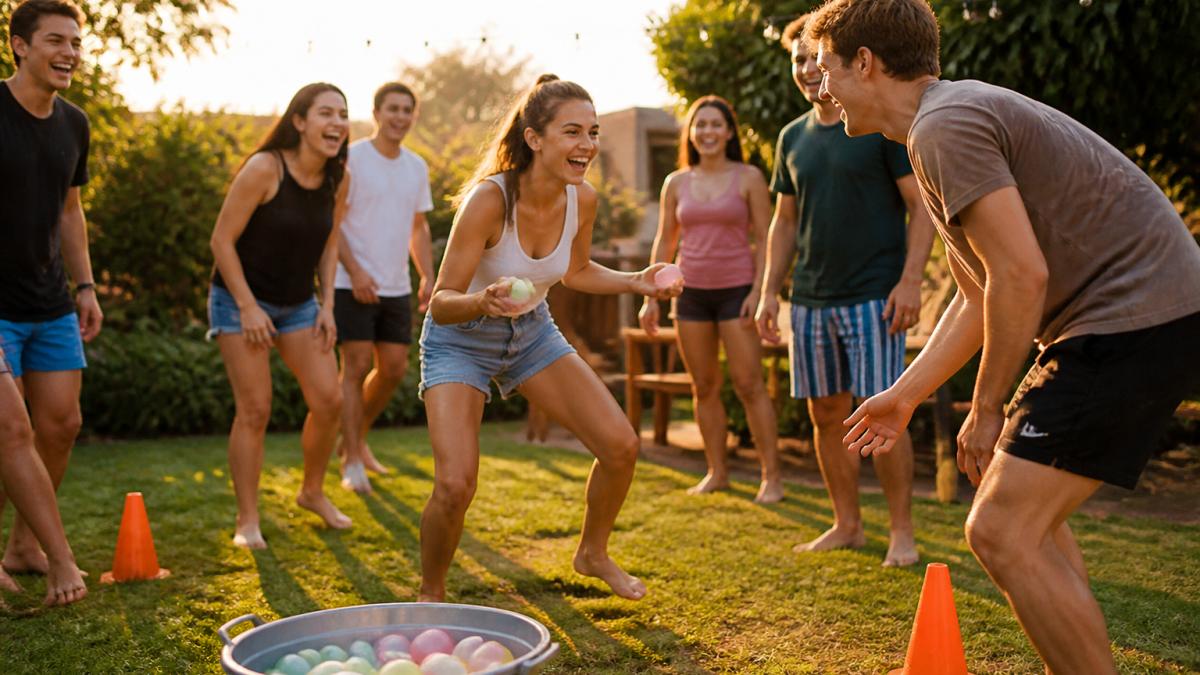
Outdoor party games are where physical activity does the entertaining for you. The best ones need a bit of space and almost no equipment.
Reliable outdoor options:
- Capture the flag. Two teams, two flags, one boundary. The classic for a reason.
- Treasure hunt. Hidden clues, teams racing to solve them. Setup takes the longest, but it buys you an hour of play.
- Hide and seek. Genuinely underrated for adults. Play it after dark with torches and it becomes a different game.
The thing nobody tells you about outdoor games is that weather changes the plan faster than anything else. Have an indoor backup ready before guests arrive, not after the first raindrop.
Mixing Ages and Abilities Without Splitting the Party
Mixed-age groups are where most hosts panic. The teenagers want something fast, the grandparents want something they can follow, and nobody wants to be sent to a separate room.
The games that work across the range:
- Team trivia lets you balance teams by mixing ages, so knowledge evens out. Seat teams around small tables rather than in rows so quieter guests can contribute without an audience.
- Fishbowl works for anyone who can read or be read to. Pair a confident reader with a guest who would rather not read aloud, and let teams confer before answering.
- Musical statues needs no reading, no scoring and no explanation. Offer a seated version where guests freeze in their chairs, so mobility is not a barrier.
Accessibility and inclusion matter here too, and this is where most lists stop short. A few practical adaptations:
- Seated versions. For any active game, offer a chair-based alternative, seated musical statues, a balloon pass rather than a relay, or a table-top version of capture the flag using tokens on a board.
- Spoken and written instructions. Read the rules aloud and hand out a one-page rules card in large print, so guests who are hard of hearing or who process text slowly are not left behind.
- Sensory considerations. Keep one room quieter and well lit for guests who find noise or flashing lights difficult, and warn the group before any game involving sudden sounds or balloons popping.
The best party games for groups are the ones nobody has to sit out. Build the adaptations in before the party starts, not after a guest looks uncomfortable, and the whole room stays in the game.
Common Party Game Mistakes to Avoid
Even a good game can flop if the host makes one of these errors. We see the same handful every time.
- Too many games planned. Two or three well-run games beat six rushed ones. Guests need time to talk between them.
- No clear host. Someone has to read rules and keep score. Otherwise the game drifts.
- Ignoring the room. A game that needs floor space will fail in a furnished front room.
- Playing past the peak. When energy drops, stop. Ending on a high note is better than grinding out one more round.
The other mistake is buying games that only work for one type of group.
Planning a gathering is the hard part. Picking the game should not be.
At The Fantastic Factory, we make games that do the work for you. The Paint Your Partner Kit turns a quiet night in into a creative challenge, with canvases, paints and brushes for two players, also £12.99.
Add one to your cart and let the game handle the small talk.
Frequently Asked Questions
How do you choose party games for a large group where half the guests don't know each other?
Start with a game that requires no skill and puts people into small mixed teams, because teams do the introductions for you. Fishbowl, team trivia and balloon relay all work well here, since nobody has to perform alone. Aim for games that take under five minutes to explain and run for 15 to 20 minutes, then swap teams so people meet someone new. Avoid anything with elimination early on, as it leaves the least confident guests sitting out while everyone else carries on.
What are the easiest party games for groups to explain to new players?
The easiest party games for groups follow one rule you can say in a sentence. Musical statues, balloon relay and team trivia all fit that test. If you need a rule written on a card, save it for later in the evening when people are warmed up. Keep a printed rules sheet for each game on the table so late arrivals can catch up without interrupting play, and nominate one person to explain rather than three people talking over each other.
Are there party games that work for mixed ages, from teenagers to grandparents?
Yes, and the trick is picking games where knowledge or speed matters less than participation. Team trivia with mixed-age teams, Fishbowl, charades and balloon relay all work across generations. Conversational games such as Can't Adult Today (£12.99, 2+ players aged 18+) suit the adults once the younger guests have gone home, so plan the evening in two halves rather than trying to find one game for everyone.
How much space and equipment do outdoor party games need?
Most outdoor party games need less than people expect. Capture the flag works in a garden of roughly 10 metres by 10 metres with two markers and two flags. Balloon relay needs a bucket, some balloons and about 5 metres of clear ground. For smaller spaces, musical statues and hide and seek need no equipment at all. Check the ground is flat and free of glass before anyone runs, and keep water games away from decking, which gets slippery fast.